
Chambers County Projected Versus Actual Release
A projected release date is an administrative estimate based on the sentence data, credits, custody class, and rules then in effect. TDCJ may also display a parole eligibility date and a maximum sentence date. Eligibility means review may begin. It is not approval. The maximum date relates to the outer sentence term. An actual release is the completed event when the custodian ends physical confinement or transfers the person to supervision or another agency.
TDCJ also distinguishes a Scheduled Release Date, Scheduled Release Type, and Scheduled Release Location. An unscheduled record may say that release is not yet scheduled. Once Classification and Records receives a release certificate, TDCJ describes an audit and calculation process that may take roughly 14 to 21 business days. Even then, the agency warns that a scheduled date may change without notice, including on release day.
A Chambers County pretrial detainee usually has no sentence-based projected date. Bond may be set, modified, posted, or held up by another warrant. A court order authorizes a legal change, while jail staff must still complete release processing. The CCSO movement record is better proof of the finished event than a bond receipt or roster disappearance.
Scheduled versus actual: A listed date shows the current plan or calculation. It does not prove that every hold cleared or that the person left custody.
Find Chambers County Projected Release Dates
Choose the search route by custodian. The TDCJ Online Offender Search is for people received into Texas prison or state-jail custody, not someone who merely bonded out of Chambers County Jail. TDCJ says the public data updates on working days and is at least one day old, so a weekend or recent transfer can create a lag.
- For a TDCJ prisoner, search with the TDCJ number or SID when known. Otherwise enter the last and first names and compare identifying details.
- Open the full detail result. Copy the labels exactly: Projected Release Date, Parole Eligibility Date, Maximum Sentence Date, and any Scheduled Release fields.
- Check the offense, county, sentence date, sentence length, and current facility to make sure the record belongs to the correct person.
- For a Chambers County Jail sentence, review the judgment and jail-credit entries in the county court portal, then ask CCSO for its current calculation.
- For pretrial custody, inspect bond and release orders, ask CCSO about current custody, and identify any transfer or outside hold.
- When the date matters, confirm through the responsible records office. Preserve the date and time of the inquiry.
The full Chambers County released inmate search connects a custody endpoint to the court disposition and durable release record. That chain is necessary when a date has passed but the person’s destination remains unclear.
The official TDCJ offender information page explains telephone and written alternatives when the online result is incomplete. A transfer from CCSO to TDCJ can take time to appear while intake records are processed.
A former Chambers County detainee does not automatically belong in the state search. If the judgment imposed only county confinement, the Sheriff and sentencing court remain the correct sources. If the court committed the person to TDCJ, the county release event may actually be a transfer. During that handoff, confirm the movement with CCSO and allow for state intake processing before deciding the state record is missing.
The official TDCJ query form shows how state identifiers and name fields begin the search.
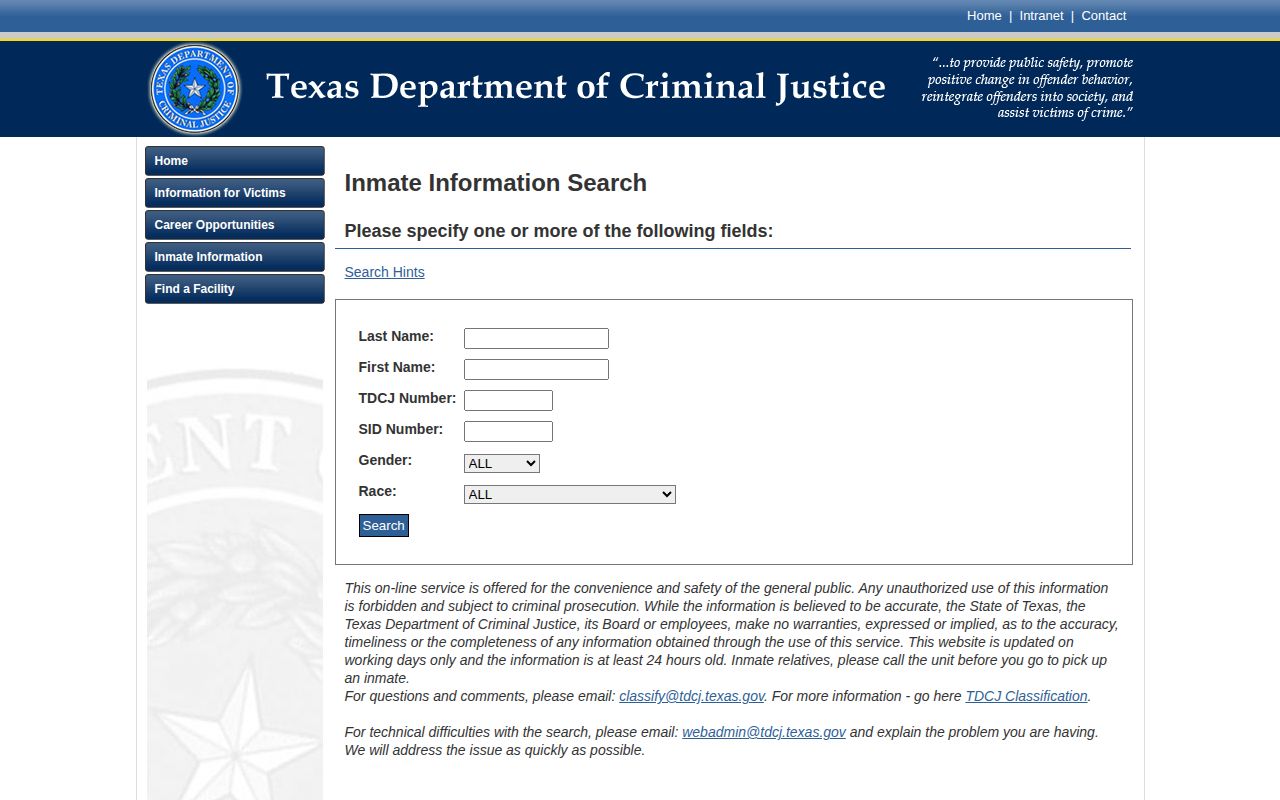
The form belongs only to the state correctional route. County jail, federal, and immigration custody require their own agencies.
Texas Good Time for Chambers Releases
Texas Government Code Chapter 498 governs good-conduct time in TDCJ. Under Government Code §498.003, good time applies to parole or mandatory-supervision eligibility as allowed by law, does not otherwise reduce the sentence, and is a privilege rather than a right. Current classifications can accrue at different rates. Trusty and Class I categories may receive twenty days for each thirty days actually served, Class II ten days, and Class III none, with possible qualifying-program credit.
Those figures are explanatory, not a safe personal calculator. Section 498.004 permits forfeiture or suspension for misconduct. Sentence data, classification, program eligibility, consecutive terms, jail credit, and statutory exclusions can alter the public projection. TDCJ’s displayed value is the current authoritative public calculation. A suspected error should go to Classification and Records through the official offender-information channel.
Texas does not impose one universal rule that every prisoner must serve eighty-five percent of a sentence. Government Code §508.145 contains offense-specific parole eligibility rules. Subsection (d), for many serious listed offenses, relies on stated calendar-time thresholds without good-conduct time and can reach one-half of the sentence or thirty years, whichever is less, subject to a minimum floor. Other legal categories use other formulas.
Mandatory supervision under Government Code §§508.147 through .149 is also category-specific. Some people are excluded, while others face discretionary review. A projected date may pass without community release. The Board can deny parole and set a later review even after eligibility begins.
Why Chambers Release Dates Change
A release projection can move when the underlying legal or custody data changes. Some changes affect the calculation. Others affect whether the person leaves for the community or goes to another custodian. The exact TDCJ or CCSO entry should control over an informal estimate.
| Factor | Possible effect | Verification source |
|---|---|---|
| Jail credit or sentence correction | Changes time credited or the sentence base | Signed judgment, amended order, and agency calculation |
| Good-time class or forfeiture | Moves an eligibility calculation or projection | TDCJ Classification and Records |
| Consecutive sentences | Changes how terms combine | Judgments and TDCJ sentence record |
| Parole decision | May approve, deny, condition, or delay release | Board status and TDCJ detail |
| Detainer or warrant | May cause transfer instead of community release | Holding and receiving agencies |
| Discipline or program condition | Can affect credits, class, or readiness | TDCJ record and current decision terms |
A favorable Board vote still may carry a future month, program condition, or other term. “In review” is not approval. A release certificate can require audit before scheduling. Physical release on parole is also not sentence discharge, since community supervision continues.
Note: Record the retrieval date because TDCJ data is not real time and a later official update may replace the displayed projection.
Confirm Chambers County Actual Release
Use notification as a prompt, not as final proof. Texas IVSS-Counties covers participating county custody and supervision data, while TDCJ maintains a separate portal for state custody, parole, and mandatory supervision. Former county offenders may disappear from the county service. Neither system replaces the source record.
The Chambers County VINELink check explains the current IVSS successor and alert process. For a state prisoner, confirm the accomplished release with TDCJ and the Parole Division when supervision follows. For a county detainee, call CCSO and request the release or movement entry. If another agency accepted custody, continue with that receiving system.
The resulting record should distinguish the release date and time, release type or code, authority, and destination. A transfer to TDCJ, another jail, federal custody, or immigration custody is not community release. A court order may explain why release was authorized but may not show the minute jail staff completed the event.
Chambers County Jail Date Calculations
TDCJ good-time formulas should not be applied to a Chambers County Jail sentence. The sentencing court controls the judgment and jail credit, while the Sheriff administers local confinement. Texas Code of Criminal Procedure article 42.032 separately permits a sheriff to grant county-jail commutation for good conduct, industry, and obedience up to the statutory limit. It also permits forfeiture for specified misconduct.
CCSO did not publish a local good-time formula in the researched material. No verified weekend or holiday early-release rule was found either. That negative finding matters. A date falling on Saturday does not justify promising a Friday release, and the maximum state-law allowance does not prove the Sheriff granted the maximum credit in one case.
Ask CCSO for the current calculated date and the data used. Then compare the answer with the judgment, sentence length, and credited days. If the person is still pretrial, replace the calculation question with a bond, court-order, and hold inquiry. The legal route changes with custody status.
A useful written request names the person, booking or cause number, sentence date, sentence length, jail credit shown in the judgment, and the specific calculated release field sought. Ask for an existing record rather than requiring new legal analysis. If a code appears, request its legend. When the Sheriff reports an outside hold or transfer destination, contact that custodian because the county date marks the end of CCSO custody, not necessarily a return to the community.
Check again near the expected date. A projection retrieved weeks earlier may not reflect a new court order, credit decision, disciplinary action, or release certificate. If the displayed date changes, keep both retrieval dates and ask the responsible agency about the source record. Avoid treating a family estimate, bond receipt, or docket summary as the final calculation. Those items can explain why release was expected, but the custodian records when the physical event was completed and where the person went.
For federal imprisonment, use the Bureau of Prisons locator rather than a TDCJ projection. For immigration detention, use the ICE locator. Neither system is a substitute for CCSO or the Chambers County court file, and a person can move between systems. The last custodian should identify the receiving agency when the event was a transfer.
The official TDCJ detail view illustrates why labels must stay distinct.
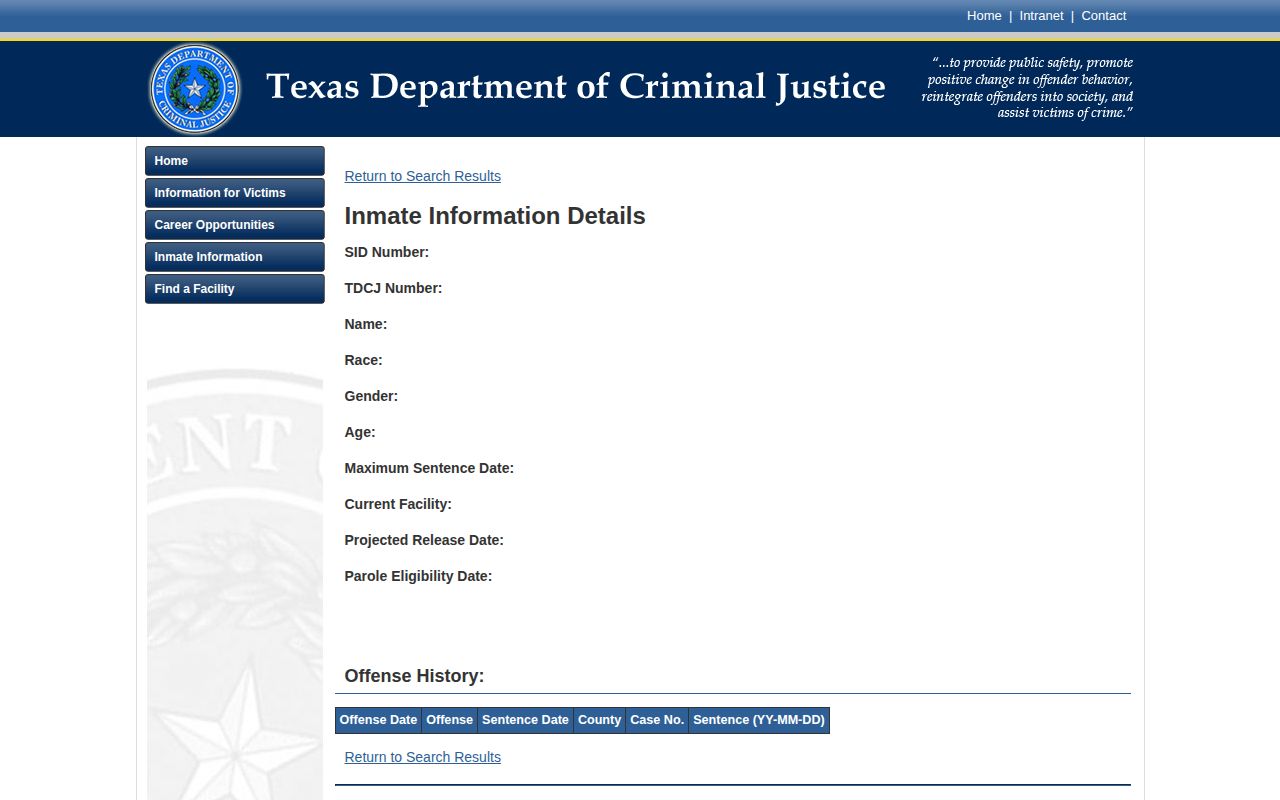
The state detail can show projected, eligible, and scheduled information, but it cannot calculate a local Chambers County Jail term.
Public Record Search
Sponsored Results